
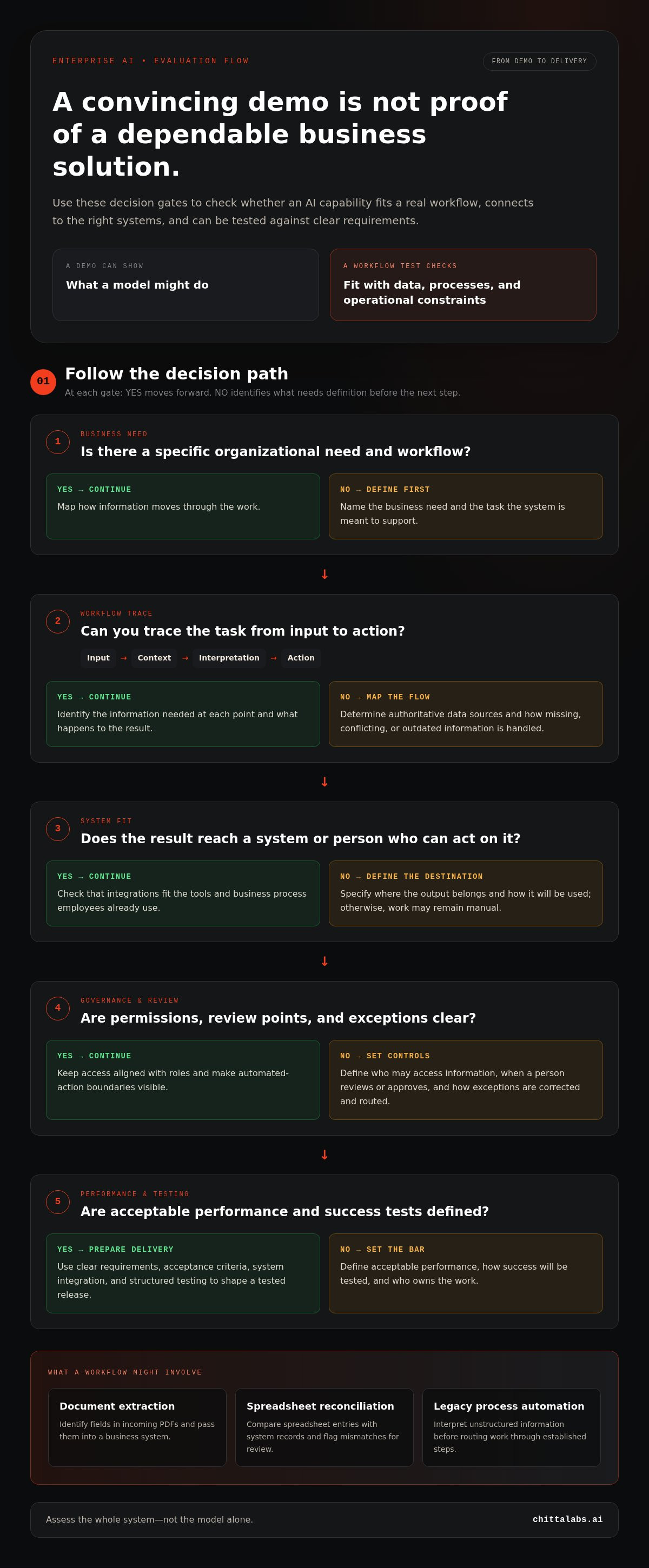
A strong model isn’t the same as a dependable business solution. Enterprise AI solutions earn their place when they fit real workflows, connect with existing systems, and meet clear performance criteria. A compelling demo can show what a model might do, but it can’t prove the solution will work with your data, processes, and operational constraints.
That’s why planning matters as much as model choice. Before a project begins, define the business need, assign ownership, set acceptable performance levels, and decide how success will be tested. Without those foundations, even capable technology can remain stuck in a pilot.
This guide explains what enterprise AI involves and how to assess workflow fit, integration, governance, and testing. It also lays out a practical path from business need to implementation, with examples such as document data extraction, spreadsheet reconciliation, and legacy process automation. The aim is to help you distinguish a useful system from an impressive demonstration.
Key Takeaways
- Enterprise AI solutions combine models with data, software, integrations, and operating processes, so assess the whole system rather than the model alone.
- Map how information moves from input to output, and define where automation ends and human decisions remain.
- Use a consistent evaluation framework to compare workflow fit, integration, reliability, governance, testing, ownership, and scope.
- Turn a defined workflow into a tested release through clear requirements, acceptance criteria, system integration, and structured testing.
- Fixed-scope delivery, system integration, testing, and code ownership can support custom AI and automation work.
What enterprise AI solutions include beyond a model or chatbot
A model can generate a response, classify information, or recognize patterns. An enterprise deployment must also fit the work around that capability: where information comes from, which systems use the result, who can access it, and what happens when the AI is uncertain. The model matters, but it’s only one part of the system.
Enterprise AI solutions are AI-enabled systems designed to address an organizational need within its data, software, workflows, and operating requirements. They can include a model, application logic, data connections, access controls, review steps, and support processes. The components depend on the task. Not every solution needs a foundation model or a custom-trained model.
How enterprise AI differs from consumer AI tools
A consumer AI tool typically helps an individual complete a task, such as drafting text or summarizing information. An enterprise solution supports a defined organizational workflow and may need to serve different teams, roles, and systems. That changes the design requirements. Employees should see only the information their role permits, and sensitive business data needs to be handled according to organizational rules.
Integration matters just as much. A useful result may need to enter a document system, update a spreadsheet, or move into an existing business process. Without those connections, employees may have to copy information between tools or repeat work manually. The system should also make clear where automated actions stop and where a person needs to review, approve, or resolve an exception.
What counts as an enterprise AI solution?
The label covers more than chatbots. A document extraction workflow might identify fields in incoming PDFs and pass them into a business system. A reconciliation process might compare spreadsheet entries with system records and flag mismatches for review. Process automation might use AI to interpret unstructured information before routing work through established steps. Each example combines AI with software, data, and a workflow, but the components depend on the task.
This broader view connects to Enterprise architecture, which considers how an organization’s systems and structures fit together. In practice, the AI component must fit within that larger environment: its inputs need a reliable source, its outputs need a destination, and its permissions and review points need to match the organization’s operating model. A standalone model demonstration rarely tests all of those conditions.
This distinction helps teams set a practical project boundary. Start with a specific business need, then identify the data, systems, users, and decisions involved. The guide Enterprise AI: A practical guide to transformation explores the wider transformation context. Here, the focus is on what makes an AI solution a working part of an organization rather than a capability viewed in isolation.
How enterprise AI solutions work across data, models, and business systems
A working AI process is a chain, not a single model call. It starts with an operational input, gathers the context needed to interpret it, applies a model or other logic, and routes the result to a system or person who can act on it. Each link needs a defined purpose. If the data is incomplete or the output has nowhere useful to go, a capable model won’t fix the workflow.
The roles of data, models, and integrations
Data supplies both the task input and the context needed to handle it. That might include a new request, relevant records from a business system, and rules describing how the request should be processed. Decide which data sources are authoritative and how the solution should handle missing, conflicting, or outdated information.
The model performs a bounded task within that process. Depending on the need, it may classify an incoming request, extract fields, interpret free-text notes, or draft a response. Software around the model prepares inputs, applies business rules, and checks whether the result is usable. The model shouldn’t be treated as the source of truth for facts held in an organization’s systems.
Integrations move information between the AI workflow and the tools employees already use. For example, a system could collect a request, retrieve relevant account details, classify its topic, and send a suggested route to a case-management system. The integration might create a draft record or flag the case for review. The design depends on the existing environment; it doesn’t require one specific cloud, platform, or architecture.
A useful implementation trace makes each responsibility visible:
- Input: A business system or employee provides the information needed for a defined task.
- Context: The workflow retrieves permitted records and applies relevant rules.
- Interpretation: The model produces a classification, extraction, or recommendation.
- Action: Software routes the result, while a person reviews exceptions or decisions that need judgment.
Where human review and controls fit
Automation needs clear boundaries. A team might allow routine, well-formed cases to proceed automatically while sending ambiguous or consequential cases to an authorized reviewer. Set review thresholds according to the cost of an error and the limits of the task, not just the model’s confidence score. Give people a way to correct outputs and return exceptions to the workflow.
Permissions, audit records, and exception handling belong in the design from the start. Access should match job responsibilities. Records should make it possible to understand what information informed an action and where a person intervened. These controls help teams operate enterprise AI solutions without assuming that automation removes oversight.
For more implementation detail, Connect AI with existing business systems focuses on the integration decisions that turn a workflow design into an operational connection. Teams shaping a custom workflow can also explore Chitta Labs’ enterprise AI work.
How to evaluate enterprise AI solutions beyond a convincing demo
A demo shows a possibility, not operational readiness. A useful evaluation tests whether the solution fits a defined workflow, works with the required systems and data, and can be operated with clear ownership. Set the criteria before comparing options. That keeps a polished interface or strong sample output from standing in for evidence of delivery readiness.
Does the solution fit a real operational need?
Start with the work, not the technology. Name the workflow, the team responsible for it, and the specific outcome the solution should support. Map its inputs, outputs, exceptions, and boundaries for automated action. For instance, a document workflow needs criteria for what information it extracts, where results go, and how incomplete or unusual records are handled. How to identify enterprise processes suited to AI explores process selection in more detail.
Can the solution be operated and governed reliably?
Evaluate the solution under the conditions the workflow will actually face. Consider data access, system connections, failure handling, testing, and who owns decisions and ongoing operation. A credible assessment includes representative cases, including ambiguous inputs and exceptions, with agreed acceptance criteria. A demo alone can’t show how the system behaves across those conditions.
Use a compact evidence check to make the evaluation repeatable:
| Criterion | Evidence to inspect |
|---|---|
| Workflow fit | A mapped process, responsible team, defined inputs and outputs, and exception paths. |
| Integration | Documented data sources, system connections, access needs, and output destinations. |
| Reliability | Results from representative cases, including incomplete or unusual inputs. |
| Governance | Defined permissions, review points, decision ownership, and records of system actions. |
| Testing | Acceptance criteria, test cases, and a method for recording defects and retesting changes. |
| Ownership | Clear responsibility for code, system changes, and ongoing operation. |
| Scope | Agreed boundaries, dependencies, deliverables, and conditions for acceptance. |
These criteria make trade-offs visible. A solution may perform well on sample inputs but need more integration work, tighter access controls, or additional human review before release. Record those gaps alongside the acceptance conditions. That gives the project a defined path from evaluation to delivery instead of an open-ended promise to improve later.
For custom enterprise AI work, explore Chitta Labs enterprise AI services, including fixed-scope delivery, system integration, robust testing, and complete code ownership.
Moving Enterprise AI from Scope to Tested Delivery
A dependable delivery path turns a workflow need into a bounded piece of work, then tests the complete system against agreed requirements. Start by identifying a repeatable task with clear inputs and a responsible team. The guide How to identify enterprise processes suited to AI covers process selection in more depth. Once you’ve chosen a candidate workflow, make the work visible before building.
Define scope and acceptance criteria before building
Write down where the workflow starts and ends, who uses it, what information it receives, and what result it must produce. Include known exceptions, such as missing data or records that need manual review. This boundary prevents a focused project from expanding into adjacent processes without an explicit decision.
Translate expected behavior into acceptance criteria. For a document workflow, criteria might specify which fields must be extracted, how the output should be formatted, and what should happen when a field is absent. For reconciliation, they might define how discrepancies are surfaced and who reviews them. Agree on how results will be assessed using representative cases, not just a successful demonstration.
Clarify ownership as well. Name the people responsible for business decisions, system access, integration dependencies, review queues, and final acceptance. Record code ownership and responsibility for future changes. Fixed-scope contracts can make project boundaries and delivery expectations explicit, provided the scope also states its assumptions and dependencies.
Plan integration, then test the complete workflow
Before implementation, map the handoffs between the AI component and existing systems. Identify the source of each input, the destination of each output, required permissions, and what the workflow should do if a connection or processing step fails. This surfaces integration work early instead of treating it as a final connection task.
- Confirm the workflow and boundaries. Document users, inputs, outputs, exceptions, and the actions the system may take.
- Plan system connections. Map data sources, access needs, destinations, and failure paths.
- Build against acceptance criteria. Keep requirements traceable to the behavior the team expects to observe.
- Test integrated cases. Cover routine inputs, edge cases, incomplete information, system handoffs, and failures.
- Review findings before release. Assign issues, refine behavior, and retest changes before routine use.
Testing the model alone isn’t enough. The release decision depends on the connected workflow, including how people receive results and handle exceptions. Set acceptance conditions before testing begins, then record whether each condition passed, failed, or needs further work. Test a custom AI system before deployment offers more detail on planning test coverage, while What enterprise AI implementation involves gives a broader view of implementation.
Chitta Labs builds custom AI layers and automated software for enterprise workflows, with system integration, robust testing, and fixed-scope delivery. Plan a scoped enterprise AI project around defined requirements and tested delivery.
How Chitta Labs builds enterprise AI solutions for defined workflows
Chitta Labs builds custom AI layers and automated software for enterprises under fixed-scope contracts. The work starts with an operational workflow, not a model chosen in isolation. This ties the project to a defined business need and makes its boundaries and delivery expectations easier to understand.
A document extraction project, for example, can focus on turning information in PDFs into usable data. A reconciliation workflow can address comparisons between spreadsheets and business systems. Legacy process automation can target work that still depends on established systems or manual steps. Each use case calls for a solution shaped around its inputs, outputs, and place in the organization’s operations.
A fixed-scope project built around the workflow
Fixed scope gives the project a clear frame. Teams can define the workflow to address, the expected deliverables, and the work outside the agreed boundary. That structure helps distinguish a defined implementation from open-ended exploration and gives delivery decisions a practical reference point.
Process automation consulting supports the work of understanding how a task operates and where automation can fit. The project can then be scoped around the relevant AI layer or automated software, with the workflow’s existing systems and users in view. Scope is not a promise of a particular business result. It sets expectations for the work, its boundaries, and how delivery will be assessed.
Integration, testing, and ownership through delivery
Enterprise AI solutions need to fit the systems that support the workflow. Chitta Labs includes full system integration in its work, connecting the custom solution with the relevant business environment rather than leaving it as a disconnected demonstration. Integration helps make the software usable within the process it was built to support.
Testing is another part of delivery. Robust testing helps assess the implemented system against the project requirements, including how its components work together. For a workflow that extracts document data or reconciles records, testing needs to consider how outputs are handled and how the surrounding system behaves, not just whether an AI component produces a plausible response.
Complete code ownership gives the enterprise ownership of the delivered code. That matters for teams responsible for maintaining their software environment and making future decisions about it. Combined with integration and testing, it provides a clear basis for understanding what is being delivered and who owns the result.
This approach suits enterprise teams with a defined workflow, relevant systems to integrate, and a need for custom automation rather than a generic demonstration. If you’re shaping a project around those requirements, discuss an enterprise AI project with Chitta Labs.
Make the next step a defined project
Choose one operational decision or task that needs to work better, then name the team accountable for it. That gives your enterprise AI solutions effort a practical starting point and a basis for deciding whether to proceed, refine the scope, or stop.
For enterprise teams, delivery structure matters as much as the technical approach. Chitta Labs works under fixed-scope project contracts, with full system integration, robust testing, and complete code ownership. These provide a clear foundation for moving from a business need to a system your organization can evaluate and own.
If you have a workflow in mind, discuss a fixed-scope enterprise AI project with Chitta Labs. A clearly defined starting point helps your team decide how to move forward.
Frequently Asked Questions
What are enterprise AI solutions?
Enterprise AI solutions are systems that apply AI to organizational tasks within the company’s data, tools, and decision-making practices. They can use existing AI capabilities or custom-built components, depending on the need. For example, an operations team might use AI to categorize incoming requests and prepare them for staff review. The key is whether the system supports a defined business task and fits the organization’s way of working.
How are enterprise AI solutions different from standard AI tools?
Standard AI tools generally provide a ready-to-use feature for an individual, while an enterprise solution is shaped around how an organization works. A team may need consistent outputs, role-based access, records of actions, and a way to manage errors across multiple users. For example, a department-wide assistant may need to reflect approved internal information and distinct user permissions, rather than respond from a single employee’s context.
What are common enterprise AI use cases?
Common use cases include sorting customer support requests, summarizing internal knowledge, preparing drafts for employee review, identifying patterns in operational data, and assisting with quality checks. The right task depends on the information available and the decision the organization needs to support. A useful starting point is a recurring activity where staff can describe what a correct result looks like and identify what should happen when the AI output is incomplete.
How do companies evaluate enterprise AI solutions?
Companies can evaluate enterprise AI solutions by testing them on representative work, not only polished examples. Compare outputs with an agreed reference, note error types, and assess how the system handles missing or conflicting inputs. Also consider the effort required to operate it and the consequences of a wrong result. A written pass-or-revise decision helps teams distinguish a promising prototype from a solution ready for its intended use.
Can enterprise AI work with existing business systems?
Yes. AI can connect with existing systems through suitable interfaces or other data exchange methods, depending on the environment. Before implementation, map which system supplies each input, what format it uses, and where the result needs to go. Access permissions and data quality also matter. If a system has limited integration options, the design may need an alternate handoff, such as a controlled file exchange or human review step.
How can an organization reduce risk when implementing enterprise AI?
Reduce implementation risk by limiting the system to an agreed task, restricting access to necessary information, and keeping human review for outputs that could cause material harm if wrong. Test with difficult cases, record errors, and define how staff can pause or correct the workflow. Assign an accountable owner before launch. These controls make it easier to detect problems early and respond without treating every output as reliable.
What should an enterprise AI project scope include?
A project scope should identify the business objective, users, workflow boundaries, required data, expected outputs, system dependencies, and acceptance conditions. It should also state assumptions and exclusions, name decision-makers, and clarify who approves changes to the work. Include testing responsibilities and how unresolved issues affect acceptance. These details help teams distinguish agreed deliverables from later requests and make project decisions easier to track.